
Encyclopedia
 current location: Home > News > Encyclopedia
 Release time:2026-09-09
 page views:
 Why is the elastomer of jaw coupling "jaw-shaped"? Understand its working principle in one article
If you have disassembled a jaw coupling, you may wonder: why is the colorful elastomer in the middle designed like petal-shaped jaws? Can it be made as a solid disc? Or a gear shape?
The answer is: The jaw shape is not an aesthetic design, but a functional design.It determines how this type of coupling transmits torque, absorbs shock, and compensates for misalignment. The working principle is explained in plain language below.
1. Three Core Components
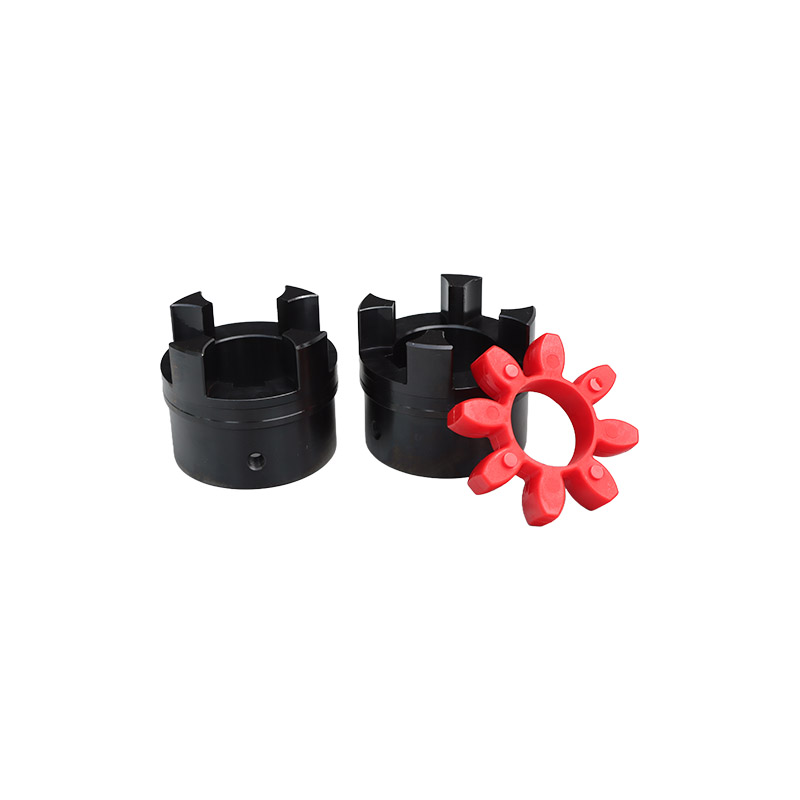
Jaw coupling (official standard name: Jaw-type elastic coupling, GB/T 5272-2017) consists of only three parts.
The driving half-coupling with jaws is made of 45# steel, cast iron or aluminum alloy. Its function is to connect the driving shaft and output torque.
The jaw elastomer is made of polyurethane (PU), cast nylon (MC nylon), etc. It transmits torque, dampens vibration and compensates for shaft misalignment.
The driven half-coupling with jaws adopts the same material as the driving half, used to connect the driven shaft and receive torque.
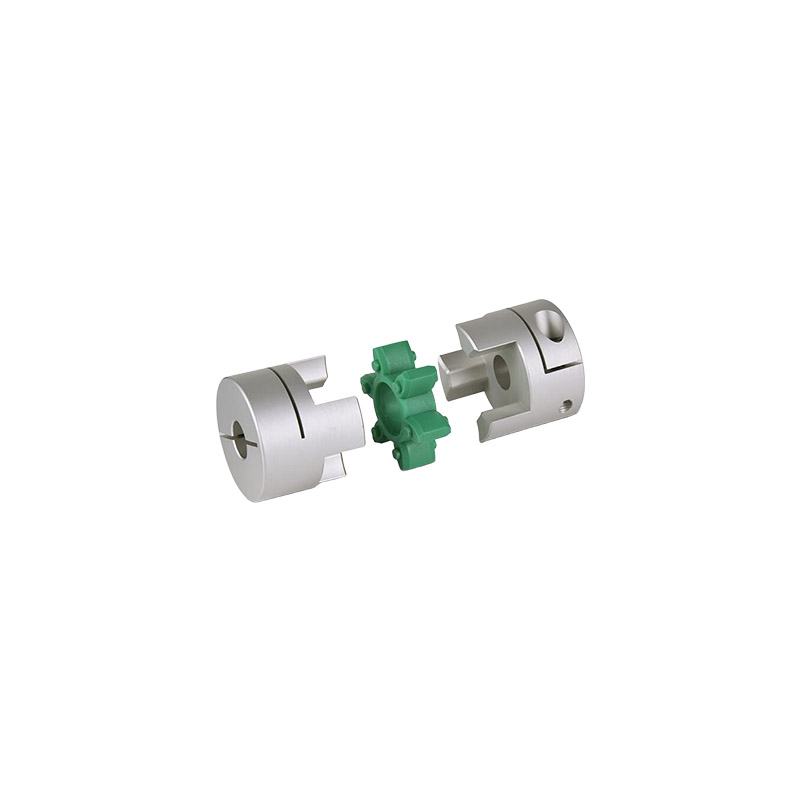
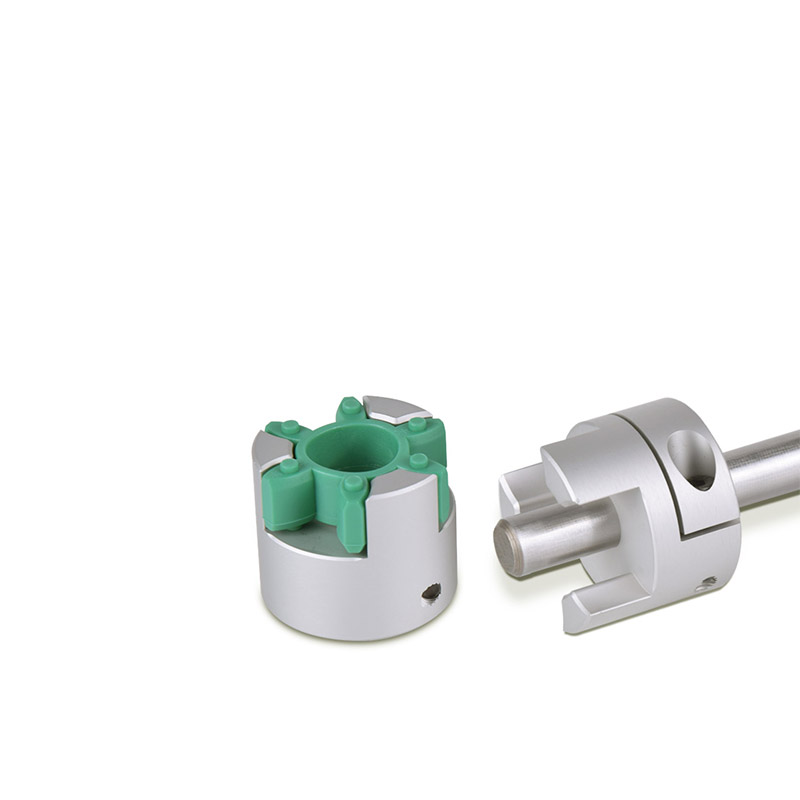
Each metal half-coupling is equipped with several jaws on its end face. A jaw elastomer with matching petal profiles is sandwiched between them. During assembly, the jaws on both sides are staggered and inserted alternately into the gaps between the elastomer petals, forming an intermeshing "tooth-slot" structure.
2. Torque Transmission Principle: By Compression, Not Tension
This is the key to understanding jaw couplings.
When the driving shaft rotates, the jaws on the driving end press against the side surfaces of the elastomer petals. The elastomer deforms under compression and transfers force to the jaws of the driven end, thereby rotating the driven shaft.
Important note: throughout operation, the elastomer is always under compressive stress, rather than tensile or bending stress. This is fundamentally different from some elastic couplings that rely on tension or bending for power transmission. Under compression, the elastomer resists fatigue cracking better, withstands heavy impact and delivers longer service life.
The elastomer is divided into multiple petals to match the staggered meshing of jaws from both halves. For example, 3 jaws on the driving side and 3 jaws on the driven side interleave into the 6 gaps of the elastomer. Common configurations include 4, 8, 10 and 12-petal versions, with every petal sharing the load.
3. Core Question: Why the Jaw Shape?
Four main reasons:
1. Evenly distributed multi-petal structure for balanced load.
Torque is shared uniformly by petals along the circumference. Each petal bears consistent load, avoiding stress concentration found in solid or single-point power transmission structures. The symmetrical jaw design delivers identical performance for forward and reverse rotation, suitable for frequent reversing applications.
2. Gaps between petals provide room for deformation.
The spaces between petals are not redundant; they are reserved space for elastomer deformation. When transmitting torque, compressed petals expand inward and outward. Under impact loads, the elastomer absorbs shock through elastic deformation enabled by these gaps. Without clearances, the elastomer cannot deform and shock absorption will fail.
3. Self-positioning petal profile prevents slipping during torque transmission.
The curved contact surfaces between jaws and petal sides create tighter contact as torque rises, eliminating slipping. This meshing structure naturally restrains axial movement without additional locking components.
4. Easy assembly and disassembly, low maintenance cost.
The jaw elastomer is a consumable part. When worn or aged, you only need to axially pull out the old elastomer and install a new one. No need to move motors or pumps; replacement can be finished within minutes. This is a major reason for its wide adoption in water pumps, fans and other equipment.
4. Three Core Capabilities Brought by Jaw Geometry
① Shock absorption and vibration damping to protect equipment.
Starting shock and load fluctuations are absorbed by the elastomer instead of being directly transferred to motor shafts and reducers, greatly reducing extra loads on shaft systems and bearings.
② Compensation for installation misalignment.
Elastic deformation of the elastomer compensates for radial, angular and axial misalignment between two shafts. Typical reference values (increase with larger frame sizes): radial misalignment 0.1~1 mm, angular misalignment 1°~3°, axial misalignment 1~5 mm. Refer to the datasheet of the selected model for exact parameters. It relaxes alignment requirements and simplifies installation.
③ Electrical insulation (for polyurethane elastomers).
Polyurethane blocks shaft current loops, reducing bearing electrical erosion caused by shaft currents in variable-frequency motors and electric machinery.
5. Elastomer Material and Hardness Determine Performance Limits
Elastomers with identical jaw shape behave drastically different with different materials:
Polyurethane (PU):Good elasticity, wear resistance and vibration absorption. Shore hardness typically ranges from 85A to 98A. It is the mainstream choice for general working conditions.
Cast nylon (MC nylon):Higher rigidity and temperature resistance, suitable for high-torque heavy-load applications, with slightly weaker damping performance than PU.
Hardness requires trade-offs: Higher hardness → higher torque capacity and longer service life, but poorer damping; Lower hardness → better shock absorption, lower load capacity and faster wear.Select hardness according to actual torque, impact level and alignment condition, and avoid blindly choosing the hardest grade.
6. Typical Applications & Summary
Jaw couplings are widely used in water pumps, fans, gear reducers, conveyors, mixers, packaging machinery, machine tools and various variable-speed drive systems. They are high-cost-performance and versatile non-metallic elastic element flexible couplings.
Summary of working principle: The driving jaws compress the jaw elastomer. The elastomer transmits torque under compressive deformation, absorbs shock and compensates for misalignment at the same time. The multi-petal staggered design of the jaw profile ensures uniform compression, available deformation space, slip-free power transmission and convenient replacement.


Hotline:
+8615066616606 hq@hqcplg.com



 No. 188 Kunlun Road, Hongyun Development Zone, Qingyun County, Dezhou City, Shandong Province