
Company
 Release time:2026-07-25
 page views:
 Aluminum alloy coupling is a precision mechanical transmission component widely adopted in industrial transmission systems. It connects the driving shaft and driven shaft to realize stable transmission of torque and rotational speed, as well as compensating axial, angular and radial misalignment generated during equipment operation. It is extensively applied in servo control, automated equipment, precision machine tools, semiconductor equipment and other fields.
I. Advantages and Disadvantages of Aluminum Alloy as Coupling Hub Material
Advantages
1.Lightweight with extremely low mass moment of inertia
The density of aluminum alloy is only one-third of steel, which greatly reduces the mass moment of inertia of transmission parts. It fits high-speed precision working conditions requiring frequent start-stop and rapid reversing of motors, effectively lowering motor load and improving system response speed. Therefore, it is a preferred material for servo motion control systems.
2.Non-magnetic and immune to magnetic interference
As a non-ferromagnetic material, aluminum alloy will not cause magnetic attraction, magnetic loss or electromagnetic interference. It meets strict requirements for non-magnetic environments in equipment such as MRI machines, precision semiconductor manufacturing devices and precision testing instruments.
3.Excellent resistance to atmospheric corrosion
A dense and stable oxide protective film will spontaneously form on the surface of aluminum, resisting erosion from the atmosphere, humid environments and common weak corrosive media. It hardly rusts and oxidizes, suitable for outdoor sites and humid workshops with general corrosive conditions.
4.Outstanding machinability, high precision and cost efficiency
Aluminum alloy features moderate hardness and is easy to cut and shape. It enables the production of couplings with complex structures and high dimensional precision with high processing yield, delivering prominent cost advantages compared with precision steel couplings.
5.Good electrical conductivity for equipotential connection
Aluminum alloy boasts favorable electrical conductivity, enabling equipotential connection between two shafts. It prevents micro-current bearing corrosion caused by shaft potential difference, applicable to transmission scenarios requiring shaft current conduction to protect bearings (it cannot achieve electrical insulation).
Disadvantages
1.Low strength, rigidity and fatigue resistance
Compared with alloy steel, aluminum alloy has inferior tensile strength, rigidity, impact resistance and fatigue strength. It cannot withstand ultra-high torque, heavy impact loads or continuous heavy-duty working conditions, so it is not suitable for heavy-duty industrial transmission equipment.
2.Limited high-temperature resistance
The aluminum alloy hub itself can withstand relatively high temperatures, while matched elastomers such as polyurethane and rubber have poor heat resistance. The maximum continuous operating temperature of standard aluminum alloy couplings is 100°C–120°C. Temperatures exceeding this range trigger elastomer aging and failure as well as attenuation of aluminum’s mechanical properties. Its temperature resistance is far lower than steel or stainless steel couplings.
3.Prone to creep under sustained load at high temperatures
Under continuous heavy loads and high-temperature conditions, aluminum alloy is more susceptible to creep (plastic deformation) than steel. This leads to attenuation of bolt preload and loose fit between sleeves. After long-term operation, transmission backlash, unstable torque transmission and even connection failure may occur.
4.Moderate wear resistance with high risk of keyway crushing
Aluminum alloy has low hardness. Compared with quenched steel, keyways, threads, fitting surfaces and other key force-bearing friction parts have poor wear resistance. Under repeated start-stop and alternating loads, keyways are vulnerable to abrasion, crushing and slipping, which constitutes the most common failure mode of aluminum alloy couplings.
II. Main Types and Characteristics of Aluminum Alloy Couplings
1. Jaw Coupling (Spider Coupling)
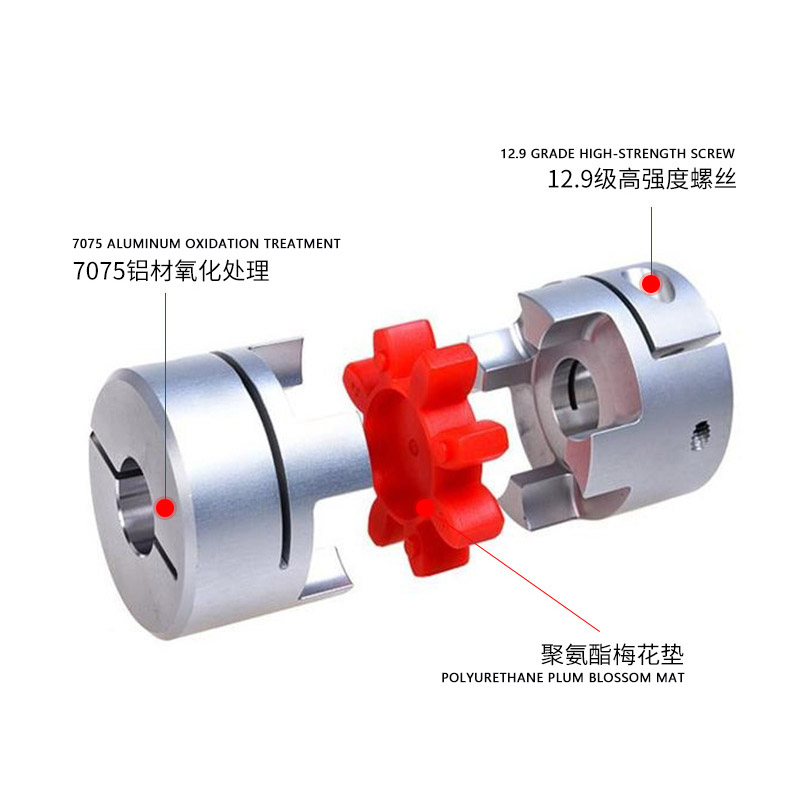
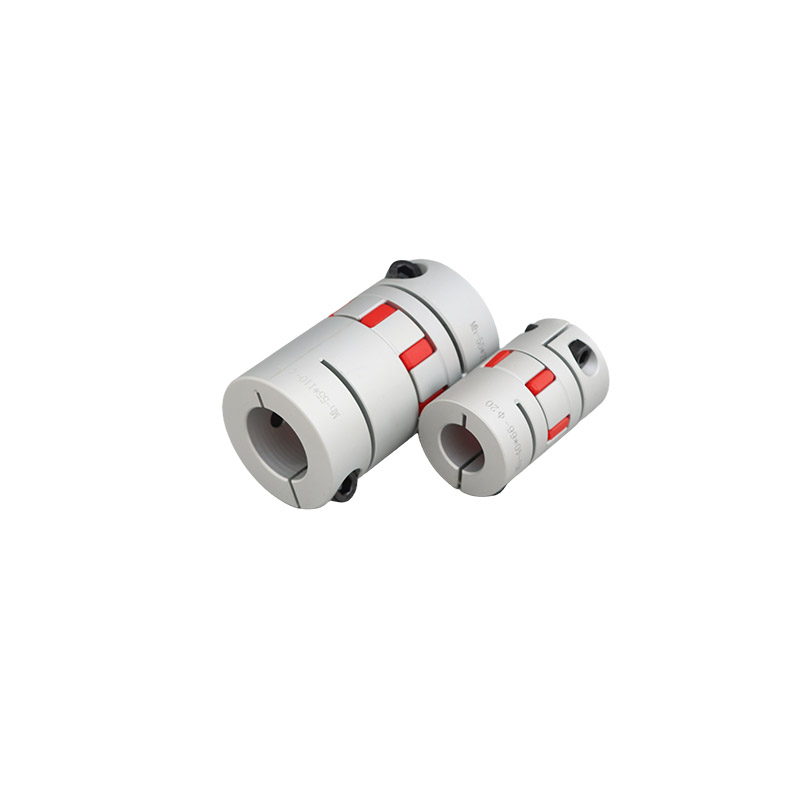
Structure: Aluminum alloy jaw hubs at both ends clamp a polyurethane or rubber spider elastomer.
Features: Excellent vibration damping, noise reduction and shock buffering performance. It compensates axial, angular and radial misalignment simultaneously. Multiple options of torsional stiffness are available. Featuring simple structure and high cost performance, it enjoys great versatility and is widely used in general servo motors, stepper motors and conveyor equipment transmission.
2. Diaphragm Coupling
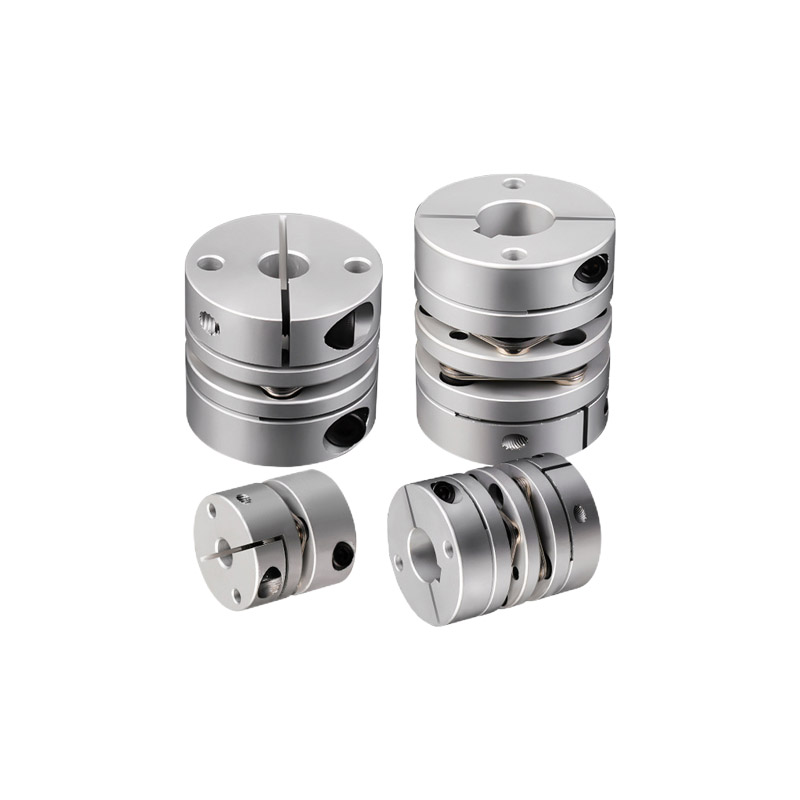
Structure: Aluminum alloy hubs on both ends transmit torque via high-strength bolts fastening multiple layers of stainless steel diaphragm packs.
Features: Zero backlash, high torsional stiffness, wear-free, maintenance-free and resistant to high and low temperatures with high precision for misalignment compensation. It fits high-end applications including high-precision servo positioning, CNC machine tools, industrial robots and aerospace precision transmission, representing high-performance precision couplings.
3. Bellows Coupling
Structure: Precision aluminum alloy hubs at two ends; the core transmission component in the middle is thin-walled stainless steel bellows. (This is the mainstream industrial structure. Fully aluminum bellows see virtually no practical industrial application due to extremely low rigidity and high deformability.)
Features: Absolute zero backlash and ultra-high torsional stiffness. It accurately compensates angular and radial misalignment with strong deformation recovery capacity. Suitable for precision positioning scenarios with small and medium torque, such as encoders, precision stepper motors and micro servo systems.
4. Oldham Coupling
Structure: Two aluminum alloy hubs sandwich a cross slider made of POM engineering plastic or alloy to realize transmission with sliding misalignment compensation.
Features: Compact structure, low cost and strong capacity to compensate radial misalignment. Under high-speed operation, friction heat generation and continuous abrasion of the slider will gradually expand transmission backlash. Its overall wear resistance fully depends on slider materials. It is only applicable to medium-low speed working conditions without ultra-high positioning accuracy requirements.
5. Rigid Coupling
Structure: Integrated one-piece aluminum alloy sleeve without any elastic compensation structure.
Features: No capacity to compensate shaft misalignment; extremely high precision of shaft alignment is required during installation. It achieves zero backlash and high rigidity at a very low cost, only adopted in fixed transmission scenarios where two shafts are perfectly aligned and pure torque transmission is required.
III. Core Factors for Aluminum Alloy Coupling Selection
Torque parameters
Calculate the rated operating torque and instantaneous peak torque of equipment separately. The rated torque of the selected coupling must exceed the maximum operating torque of equipment with sufficient safety margin, so as to bear instantaneous impact torque and avoid slipping, deformation and damage.
Operating rotational speed
The maximum allowable rotational speed of the coupling must be higher than the maximum operating speed of equipment. Benefiting from lightweight aluminum alloy, such couplings feature low mass moment of inertia and favorable stability at high speeds, generally suitable for high-speed transmission conditions.
Requirement for misalignment compensation
Evaluate axial float, angular deviation and radial eccentricity generated during equipment operation in advance. Select coupling models with corresponding compensation capacity according to deviation magnitude. Excessive misalignment will result in equipment vibration and component abrasion.
Requirement for transmission backlash
High-precision positioning systems such as robots, CNC machine tools and precision testing equipment must adopt zero-backlash diaphragm couplings or bellows couplings. General-purpose transmission equipment can use jaw couplings or Oldham couplings with slight buffer backlash.


Hotline:
+8615066616606 hq@hqcplg.com



 current location:
  No. 188 Kunlun Road, Hongyun Development Zone, Qingyun County, Dezhou City, Shandong Province